
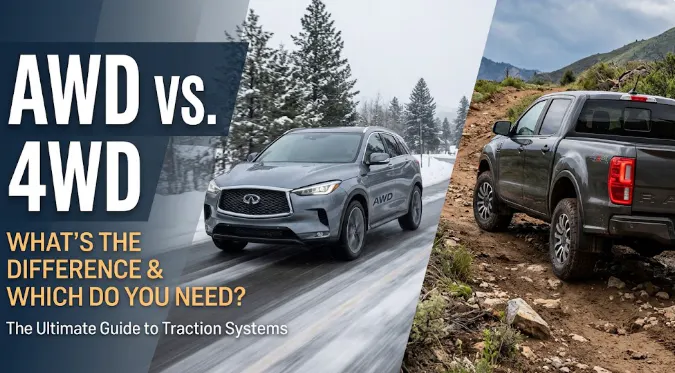
AWD vs. 4WD: What’s the Difference and Which Do You Need?
City Auto Used Vehicle Guide
AWD vs. 4WD: Key Differences Explained Simply
Learn how all-wheel drive and four-wheel drive differ, which system fits different driving conditions, and what to check when buying an AWD or 4WD used vehicle.
AWD and 4WD can both send power to all four wheels, but they do not necessarily work the same way and the difference matters when you are shopping for a used vehicle.
All-wheel drive, or AWD, is commonly designed to manage power distribution automatically as road conditions change. Four-wheel drive, or 4WD, is commonly found on trucks and more capability-focused SUVs and may give the driver direct control over modes such as 2WD, 4WD High, and 4WD Low.
Modern systems can blur those lines. Some trucks offer an automatic four-wheel-drive mode that behaves differently from traditional part-time 4WD, while AWD systems themselves vary significantly by manufacturer.
Quick Answer
AWD generally makes the most sense for drivers who want automatic additional traction during everyday driving, wet roads, changing surfaces, and light-duty unpaved travel. Traditional 4WD is usually the stronger fit for trucks and SUVs that regularly encounter loose terrain, job sites, deep mud, steep grades, or situations where low-range gearing is useful.
AWD vs. 4WD Guide
How AWD and 4WD Work
Both AWD and 4WD can power all four wheels. The main difference is how and when that power reaches them.
How All-Wheel Drive Works
AWD systems are generally designed to operate with little or no intervention from the driver.
Some are full-time AWD, meaning power is continuously available to both axles. Others are on-demand AWD. In normal conditions, the vehicle may primarily drive one axle, then send power to the other axle when sensors detect a need for additional traction.
AWD is particularly common on:
- Crossovers
- Family SUVs
- Sedans
- Performance vehicles
- Some minivans
- Some electrified vehicles
How Traditional 4WD Works
Traditional four-wheel drive is especially common on pickup trucks and more rugged SUVs. Many systems normally operate in rear-wheel drive and allow the driver to engage four-wheel drive when additional traction is needed.
Common 4WD settings:
2H or 2WD High: Power is sent to two wheels usually the rear wheels on a pickup.
4H or 4WD High: Power is sent to both axles for loose, slippery, or demanding terrain.
4L or 4WD Low: Low-range gearing provides additional torque multiplication and low-speed control for more challenging terrain.
What Is 4WD Auto or 4A?
This is where the AWD-vs.-4WD distinction becomes less obvious.
Some modern trucks offer 4WD Auto, often labeled 4A or AUTO 4WD. In an automatic 4WD mode, the truck can adjust power between the front and rear axles as traction conditions change.
Used-shopping tip: Do not assume every four-wheel-drive truck operates the same way. Check whether the selector includes 2H, 4A/AUTO, 4H, and 4L.
AWD vs. 4WD Comparison
| Category | AWD | Traditional 4WD |
|---|---|---|
| Driver involvement | Usually automatic | Often selectable by driver |
| Normal road use | Excellent fit | Usually 2WD or Auto mode |
| Wet pavement | Strong use case | Auto 4WD may help if equipped |
| Gravel roads | Good | Very good |
| Deep mud or sand | Capability varies | Usually better suited |
| Low-range gearing | Usually no | Available on many systems |
| Common vehicle type | Crossovers and SUVs | Trucks and truck-based SUVs |
| Learning drivetrain modes | Usually minimal | Often important |
Neither column automatically means “better.” The right system depends on how you actually use the vehicle.
Which One Fits How You Drive?
Everyday Driving and Rain
For a commuter or family vehicle, AWD can be easy to live with because the driver generally does not have to think about when to engage it. The vehicle manages power distribution automatically.
AWD does not increase tire grip by itself, however. Tires remain critical to acceleration, cornering, and braking.
Gravel and Unpaved Roads
Either system can work well for maintained gravel roads. AWD may be completely sufficient for a crossover that regularly travels down a gravel driveway or maintained rural road.
A truck with 4WD becomes more useful as conditions become rougher, deeper, steeper, or less predictable.
Boat Ramps
AWD can provide useful traction on wet pavement. A 4WD truck may offer additional control when launching or recovering a boat from a steep or loose ramp, particularly when it also offers selectable modes and suitable tires.
Towing capacity, payload, tongue weight, brakes, tires, and the truck’s exact configuration still matter independently of drivetrain.
Job Sites
For drivers regularly entering construction sites, muddy fields, loose gravel, or uneven terrain, traditional 4WD often provides useful additional capability. Low range may be particularly valuable when the goal is controlled movement rather than speed.
Light Off-Road Use
Many AWD crossovers can handle maintained trails, gravel, packed dirt, and similar light-duty surfaces. As terrain gets more demanding, look beyond drivetrain and consider:
- Ground clearance
- Approach and departure angles
- Tires
- Skid plates
- Suspension
- Low-range gearing
- Locking differentials
- Recovery points
AWD vs. 4WD for Tennessee and Alabama Driving
| AWD May Fit Better If You… | 4WD May Fit Better If You… |
|---|---|
| Spend most of your time on paved roads | Regularly use loose or rough surfaces |
| Want automatic traction management | Visit muddy job sites |
| Prefer a crossover or family SUV | Want a pickup or truck-based SUV |
| Occasionally travel on gravel | Use steep or slippery boat ramps |
| Do not need low range | Want selectable 4H and 4L |
Compare Your Options
Shop AWD and 4WD Vehicles at City Auto
Browse used cars, trucks, crossovers, and SUVs and use the drivetrain filter to narrow the inventory.
How to Identify AWD or 4WD on a Used Vehicle
Do not rely on appearance. Many vehicles are sold in both front-wheel-drive and AWD versions, while pickups may be available in both 4×2 and 4×4 configurations.
Start With the Used-Vehicle Listing
City Auto’s used inventory includes a drivetrain filter. Depending on the vehicle, you may encounter terms such as:
- AWD
- 4WD
- 4×4
- 4×2
- FWD
- RWD
AWD vs. 4WD vs. 4×4
AWD means all-wheel drive. 4WD means four-wheel drive. 4×4 is commonly used on trucks to describe a four-wheel-drive configuration. 4×2 means the vehicle has four wheel positions with two driven wheels.
Look Inside the Vehicle
A traditional 4WD truck often has a selector showing some combination of 2H, 4A/AUTO, 4H, and 4L. An AWD vehicle may have no drivetrain selector because the system operates automatically.
Check the VIN and Original Equipment
If drivetrain is essential to your purchase, verify it through the VIN, vehicle documentation, original equipment information, or manufacturer resources. A badge can be removed and listing data can occasionally contain errors.
What to Test on a Used AWD or 4WD Vehicle
Check the Tires First
Look at all four tires and check:
- Matching tire sizes
- Similar tire type
- Comparable tread wear
- Tire pressure
- Uneven wear
- Sidewall damage
- Remaining tread depth
Why it matters: AWD and 4WD systems can be sensitive to significant differences in tire circumference. A vehicle with one nearly new tire and three heavily worn tires deserves a closer look.
Check for Warning Lights
Make sure AWD, 4WD, ABS, traction-control, or stability-control warning lights do not remain illuminated when they should not.
Test Selectable 4WD Modes
When appropriate and according to the owner’s manual, verify that the applicable modes engage correctly. Watch for:
- Warning messages
- Failure to engage
- Grinding
- Binding
- Heavy clunks
- Persistent unusual noises
Do not test 4H or 4L on dry, high-traction pavement when the owner’s manual says those modes are intended for loose or slippery surfaces.
Test 4WD Low Correctly
4L generally requires a specific engagement procedure and is intended for low-speed operation. Some vehicles require the transmission to be in Neutral and the vehicle to be stopped or moving very slowly. Follow the procedure for the specific vehicle.
Listen During Normal Driving
Listen for unusual:
- Humming
- Whining
- Clicking
- Grinding
- Vibration
- Clunks during acceleration or deceleration
These symptoms can have several causes, but unusual drivetrain noise deserves inspection before purchase.
Look Underneath
Check for visible leaks around differentials, transfer-case components, and driveshaft areas. Also look for signs of significant off-road impact or damage.
Tire Condition Matters More Than Many Buyers Realize
AWD and 4WD improve the vehicle’s ability to send power to available traction. They cannot create traction that the tires do not have.
Worn tires can reduce wet-road and loose-surface grip regardless of drivetrain. Check tread depth, tire age, damage, inflation, and whether all four tires meet the manufacturer’s specifications.
AWD and 4WD vehicles may also require special care when replacing tires because differences in circumference can affect drivetrain operation. Follow the vehicle manufacturer’s tire-replacement requirements.
Fuel Economy and Maintenance Tradeoffs
AWD and 4WD systems can add components such as:
- Additional driveshafts
- Differentials
- Transfer-case or power-transfer hardware
- Clutches
- Electronic control systems
That added capability can bring additional weight and mechanical drag, so an AWD or 4WD version may have lower EPA fuel-economy ratings than an otherwise comparable 2WD vehicle. The difference varies by model.
Fluids Matter
Some AWD and 4WD systems have separate differential, transfer-case, or gear-oil service requirements. Intervals and fluid specifications vary, so review the service history and owner’s manual.
Tire Replacement Can Cost More
On some AWD and 4WD systems, significant differences in tire circumference or tread depth can be undesirable. Depending on manufacturer requirements and the condition of the remaining tires, replacing one damaged tire may require additional tire replacement or a closely matched replacement.
AWD vs. 4WD: Ownership Reality Check
The system you do not need is not automatically an upgrade.
AWD can be useful, but if you drive almost entirely on paved roads and rarely encounter poor traction, a FWD or RWD vehicle on good tires may meet your needs while using less fuel and having fewer drivetrain components.
Likewise, 4WD Low sounds impressive, but a pickup that spends its life commuting and making highway trips may rarely use it.
Buy capability based on your real driving rather than the most extreme scenario you can imagine.
Key Takeaways
- AWD and 4WD can both power all four wheels, but they operate differently.
- AWD usually manages traction automatically.
- Traditional 4WD often provides selectable modes such as 2H, 4H, and 4L.
- Some modern trucks also offer Auto 4WD or 4A.
- AWD is often a strong fit for everyday paved-road driving and changing traction.
- 4WD is generally better suited to demanding loose terrain and low-speed off-road use.
- Ground clearance and tires can matter as much as drivetrain.
- Check the listing, controls, VIN, and vehicle documentation before assuming which system a used vehicle has.
- Inspect all four tires carefully on a used AWD or 4WD vehicle.
- Warning lights, unusual noises, leaks, or failure to engage deserve further inspection before purchase.
Frequently Asked Questions
Is AWD the same as 4WD?
No. Both can power all four wheels, but AWD usually manages torque distribution automatically, while traditional 4WD often gives the driver more direct control over when four-wheel drive is engaged.
Is AWD or 4WD better?
Neither is universally better. AWD can be ideal for everyday driving and changing road conditions. Traditional 4WD is generally better suited to vehicles that regularly encounter loose terrain, deep mud, steep grades, or situations requiring low-range gearing.
Is AWD good in rain?
AWD can help a vehicle use available traction when accelerating on a wet surface. Tires remain critical, and AWD does not eliminate the need to slow down or increase stopping distance in poor conditions.
Is 4WD better than AWD for off-roading?
Traditional 4WD is generally better suited to demanding off-road use because many systems include selectable 4H and low-range 4L. Tires, ground clearance, suspension, skid plates, and other hardware also determine off-road capability.
What is 4WD Auto?
4WD Auto, sometimes labeled 4A or AUTO 4WD, is a mode available on some four-wheel-drive vehicles that automatically varies power between the axles as traction conditions change.
What is 4WD Low?
4WD Low uses low-range gearing to provide additional torque multiplication and low-speed control. It is intended for challenging terrain such as deep sand, mud, rocks, or steep grades, depending on the vehicle.
Should I use 4WD High on dry pavement?
On many traditional part-time systems, 4H is intended for loose or slippery surfaces and should not be used on dry, high-traction pavement. Some vehicles provide an Auto 4WD mode specifically for variable road conditions. Follow the owner’s manual for the individual vehicle.
Does AWD help you stop faster?
AWD primarily affects how power reaches the wheels. It does not replace tire traction or change the fundamental limits of braking. Tire condition, road surface, speed, brakes, and stability-control systems remain critical.
Does AWD use more gas?
It can. AWD adds weight and drivetrain components, so an AWD version may have lower EPA fuel-economy ratings than a comparable FWD or RWD version. The actual difference varies by vehicle.
How do I know whether a used vehicle is AWD or 4WD?
Check the listing’s drivetrain information, look for AWD or 4WD controls, and confirm the system through the VIN or manufacturer information. City Auto’s used-inventory search also includes a drivetrain filter.
Should all four tires match on an AWD vehicle?
Follow the manufacturer’s requirements. AWD and 4WD systems can be sensitive to differences in tire size and circumference, so matching tire specifications and similar wear levels are important.
What should I test when buying a used 4WD vehicle?
Check tires, warning lights, fluid leaks, unusual drivetrain noises, and the operation of the applicable 4WD modes. Follow the owner’s manual when testing 4H or 4L.
See a CAzillion. Find the One.
Compare AWD and 4WD Vehicles at City Auto
Search cars, trucks, crossovers, and SUVs across City Auto locations and use the drivetrain filter to narrow the inventory to vehicles that fit how you drive.
More Used Vehicle Guides From City Auto
Truck Comparison
Ford F-150 vs. Chevy Silverado 1500 by Model Year
Compare two popular used full-size trucks across engines, generations, towing, MPG, and configurations.
Ford Towing Guide
Ford F-150 Towing Capacity by Year and Engine
See how F-150 towing capacity changes by engine, drivetrain, cab, bed, axle ratio, and model year.
Chevrolet Towing Guide
Chevy Silverado 1500 Towing Capacity by Year and Engine
Compare Silverado towing ratings and learn why 2019 LD and 2022 LTD trucks require extra attention.
Used Truck Research
Which Used Truck Is the Most Reliable?
Learn what to consider when comparing reliability across popular used pickup trucks.
